Inside Rokarolla: Hardening Android Apps Against Two-Stage Banking Trojans
An architectural deep dive into the Rokarolla malware discovered by Zimperium zLabs. Learn how it exploits InMemoryDexClassLoader and how to audit your ClassLoader chain.
AG Mobile Labs•30 min read•
Rokarolla TrojanAndroid SecurityInMemoryDexClassLoaderDropper MechanicAG Mobile LabsMobile App HardeningAndroid StudioC2 InfrastructureMobile SecurityKotlin
⚡TL;DR
- The Threat: Discovered in June 2026, Rokarolla is a highly evasive Android banking trojan targeting 217 financial applications with a destructive library of 137 remote control commands.
- The Evasion Mechanic: The malware bypasses traditional filesystem monitors and static analysis sandboxes by using
InMemoryDexClassLoaderto load its encrypted malicious.dexpayload straight into volatile device RAM without ever touching physical disk storage. - The Consequence: Once active via manipulated Accessibility Services, it enforces absolute victim isolation—systematically blocking incoming fraud-team calls, muting device notifications, and intercepting SMS OTP codes.
- The Architectural Vulnerability: Standard viewport-level patches like
filterTouchesWhenObscuredor high-levelAccessibilityManagersystem checks can be blindfolded or bypassed if a trojan compromises your application’s underlying process space. - The Ultimate Resolution: To achieve true defense in depth, enterprise applications must move beyond basic UI checklists and implement continuous Runtime ClassLoader Audits to actively verify process integrity and detect fileless code injections.
The Evolution of Mobile Victim Isolation
In mid-June 2026, the mobile threat landscape shifted under the weight of a newly uncovered entity. Security researchers at Zimperium zLabs documented and exposed Rokarolla, a highly invasive Android banking trojan named directly after its resilient command-and-control (C2) server infrastructure. Distributed through highly polished phishing networks masquerading as trusted downloads for Google Chrome or TikTok, Rokarolla marks a dark evolution in mobile crimeware—transitioning from basic data-theft utilities into an absolute device takeover vehicle.
Historically, mobile banking malware operated like digital pickpockets: they slipped into a device, quietly scraped login credentials or intercepted specific keystrokes, and exfiltrated the data back to an attacker for later exploitation. Rokarolla completely breaks this paradigm. It does not simply want to steal your data; it is engineered to weaponize the operating system against its host, trapping the user in a profound information vacuum.
-
[Traditional Malware] ──────► [Passive Data Theft (Steal Logins & Leave)]
-
[Rokarolla Trojan] ──────► [Full Device Takeover + Total Victim Isolation]
Once established within the device’s runtime environment, Rokarolla shifts focus entirely toward victim isolation. It hijacks default system handler roles to systematically block incoming telephone calls from fraud prevention teams, read and reply to text messages on behalf of the user, suppress audio and haptic vibration feedback loops during fraudulent transfers, and actively deactivate local Google Play Protect engines. The user is left holding a physical phone that is effectively invisible to their own control, while automated transactions run smoothly in the background.
The sheer scale of this threat is underscored by its core operational metrics:
- 217 Targeted Applications: The trojan contains a precise target index tracking over 200 distinct financial, retail banking, and cryptocurrency wallet packages globally.
- 137 Individual Remote Commands: Exceeding the capabilities of previous heavyweights like the HOOK trojan (which capped out at 107 instructions), Rokarolla's C2 payload arsenal provides threat actors with absolute, granular administrative control over screen node rendering, clipboard manipulation, and memory state execution.
The Multi-Stage Attack Chain: Exploiting Trust and Architectural Bounds
To understand how Rokarolla completely compromises a device, we have to look past the high-level social engineering and map its concrete execution steps. The malware relies on a highly coordinated, two-layer attack framework that carefully separates the initial external bait from its runtime payload architecture.
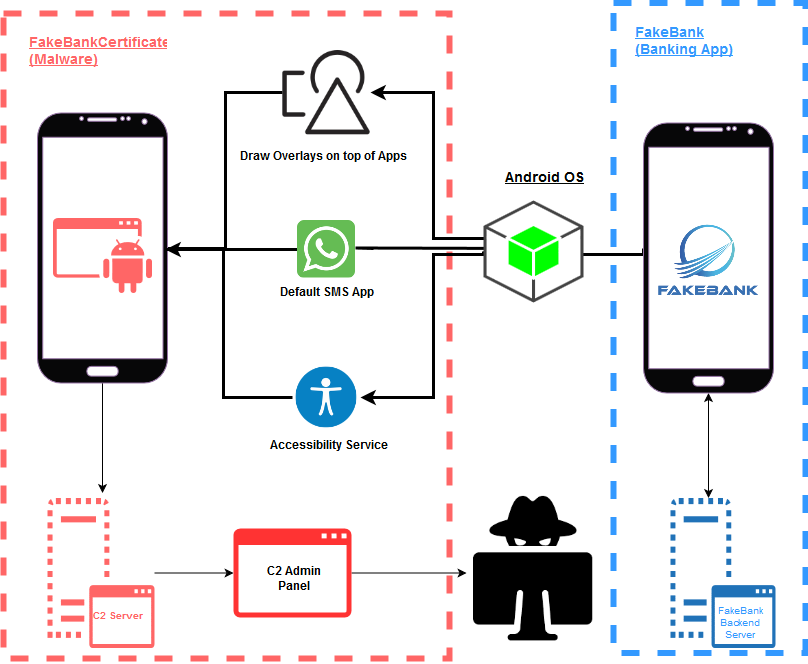
The Android Mobile Overlay and System Privilege Interception Chain. Source: IKARUS Security
Phase 1: The External Lure (Web Infiltration)
The attack chain begins completely outside the official Google Play ecosystem. Threat actors deploy highly sophisticated phishing websites or targeted malicious advertisements designed to mimic legitimate web properties. The primary lures identified in the wild include:
- Modded or region-specific distribution pages for TikTok and Google Chrome.
- Deceptive streaming utilities built around major events like the 2026 World Cup.
When a user interacts with these platforms, they download an external Android Application Package (APK) file. At this stage, the file is entirely a dropper—a shell package designed to minimize its static code footprint and bypass basic signature heuristics.
Phase 2: The Google Play Protect Illusion (The Dropper Mechanic)
Once the user manually installs and runs the downloaded APK, the application immediately discards its initial "TikTok" or "Chrome" visual identity. It launches a persistent, full-screen custom user interface that perfectly mimics a native Google Play Protect system diagnostic scan.
By leveraging immediate visual panic, the dropper screen alerts the user that their device security definitions are outdated and demands an "essential security engine update" to proceed. When the user taps the confirmation button on this fake wizard interface, they are not updating their security configuration—they are actively granting the app complete administrative control over the Android subsystem via Accessibility Services.
Phase 3: Weaponizing Android's Accessibility Engine
Android’s Accessibility infrastructure is natively engineered to assist users with physical or visual impairments by allowing background services to read screen layouts, track user input events, and simulate physical taps on the display window. Rokarolla weaponizes this exact subsystem to bypass core Android sandbox security rules.
Once the user approves the Accessibility permission on the fraudulent Play Protect wizard, Rokarolla gains the programmatic authority to:
- Monitor Target Process States: It intercepts global window focus events, noting exactly when one of the 217 tracked banking or crypto applications moves into the foreground.
- Automate UI Interaction: The dropper calls the native Android Package Installer API in the background. It then uses its Accessibility nodes to silently auto-click the "Install" and "Allow" options on its secondary payload APK without the user ever seeing an installation prompt fly by.
- Enforce Total Device Blackouts: It leverages its system permissions to disable the real Google Play Protect engine, modify system audio parameters to mute incoming voice alerts, and set itself as the device's default SMS and Call Management handler.
Through this elegant separation of phases, the dropper shifts the attack vector from a standard network-level exploit into a legitimate, system-authorized compromise of the operating system's trust model.
ℹ️Info
Takeaway for Developers: The structural trap of Rokarolla proves that once an application secures an active Accessibility Service footprint on a user's phone, it can fully read and interact with standard view hierarchies. As developers, we cannot assume our local data is safe simply because our transport layers are encrypted. We must actively defend our views against unauthorized reading.
Dynamic Payload Execution: The Mechanics of Overlay Theft and Surveillance
Once Rokarolla establishes its subsystem permissions, it drops its pseudo-security guise and shifts into active runtime exploitation. It stops acting like an installer and begins functioning as an aggressive Remote Access Trojan (RAT), driven by its command-and-control (C2) infrastructure to harvest data without triggering system warning thresholds.
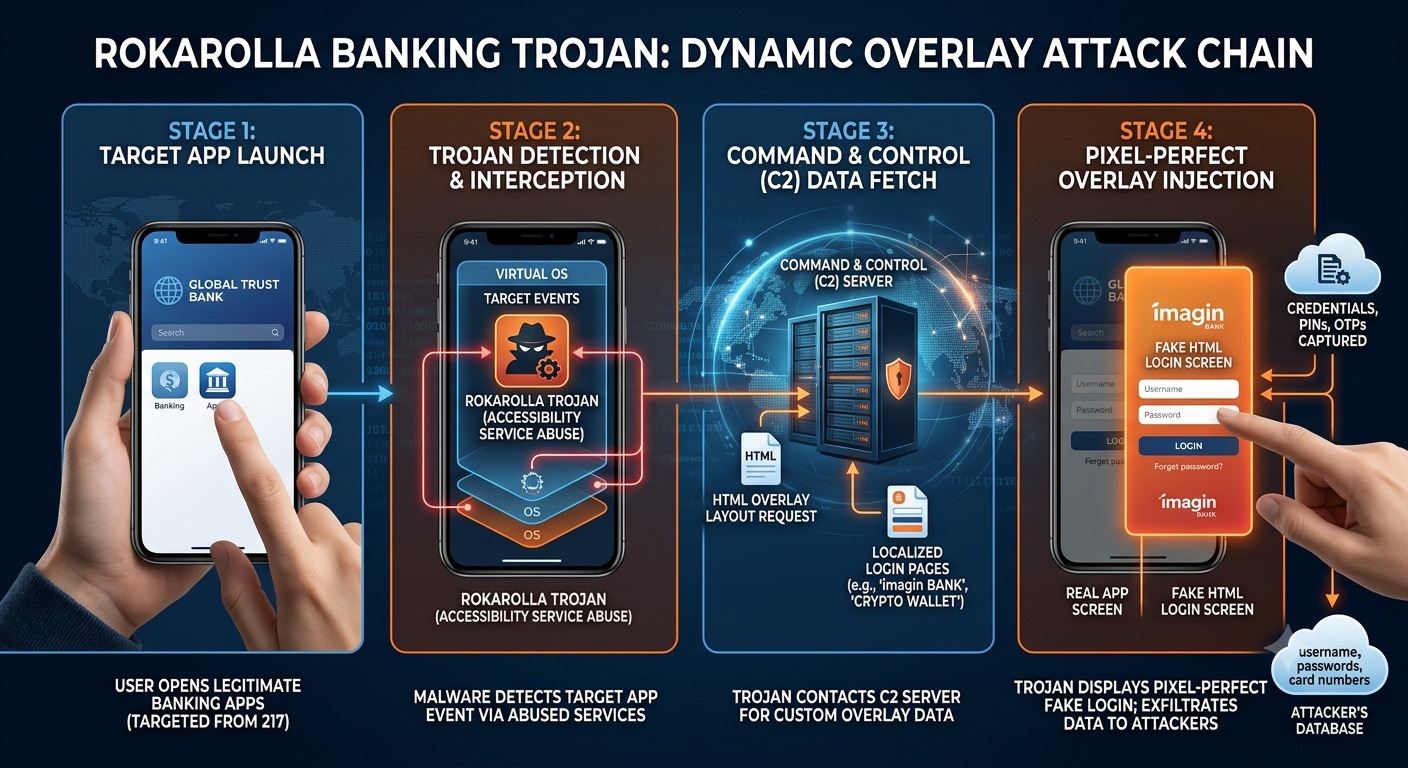
The HTML Overlay Injection Subsystem
The core mechanism for stealing banking and cryptocurrency credentials is the overlay attack. Instead of packing hundreds of heavy, static phishing pages directly inside the APK—which would balloon the file size and trigger heuristic flags—Rokarolla utilizes a dynamic, data-driven injection engine:
- Process Monitoring: The malware continuously parses on-screen window state changes via the abused Accessibility Service. The moment a user taps and launches any package matching its 217-app target index (such as imagin or major crypto wallets), Rokarolla intercepts the window lifecycle event.
- On-Demand Payload Delivery: It queries its C2 server using the unique Bot ID assigned to the infected device, fetching a customized, pixel-perfect HTML phishing layout tailored to that specific application.
- The Viewport Hijack: The trojan draws this web view directly over the legitimate app interface. Because the overlay is exact down to the layout margins and brand assets, the victim believes they are interacting with their secure banking terminal. When they type their account IDs, passwords, or credit card details, the inputs bypass the real application completely and stream straight to the attacker's server.
Lock Screen Credential Harvesting
Rokarolla extends this overlay technique beyond financial applications to target the Android OS itself. It can programmatically force a full-screen, deceptive clone of the native Android system lock screen over the viewport.
When the user enters their PIN, pattern, or alphanumeric password to unlock their phone, the malware intercepts the event, records the string, and exfiltrates it. This allows threat actors to maintain persistent access and execute administrative background commands even when the device is locked or asleep.
Contextual Surveillance & Clipboard Hijacking
Beyond passive credential collection, the malware contains built-in modules designed to continuously strip away user privacy:
- Screen-Content Parsing (WhatsApp Scraping): By abusing accessibility node parsing, Rokarolla reads textual structures displayed on the screen. It actively filters active layouts against targeted structural strings (e.g., searching for keywords like 'Chats', 'Calls', or 'New group' inside WhatsApp) to scrape localized contact data, message bodies, and metadata.
- Silent Timestamped Screenshots: Rather than streaming live video feeds—which causes high battery drain and network spikes that look suspicious—Rokarolla takes rapid, silent device screenshots, compresses them into compact PNG formats, and queues them for low-profile exfiltration.
- Asynchronous Keylogging: Every keystroke across non-targeted applications is tracked and recorded to catch secondary passwords, security answers, or personal communications.
- Cryptocurrency Clipboard Swapping: The malware constantly monitors the system clipboard state. If a string matching the structural regex of a Bitcoin, Ethereum, or other crypto wallet address is copied, Rokarolla instantly swaps it out in memory with an attacker-controlled wallet address. If the user pastes the address into a legitimate transaction screen, the funds are permanently routed to the threat actor.
⚠️Warning
The Subtle Threat of Accessibility Abuse: It is critical to understand that Accessibility Services are not inherently malicious; they are foundational for users with disabilities. However, their capacity to read screen content and simulate user input creates a 'privileged API' vulnerability. As developers, we must be aware that if an attacker successfully tricks a user into granting this permission, the resulting malware can operate with impunity, bypassing standard sandbox restrictions.
Security Note: Traditional signature engines fail against this approach because the malicious UI elements are fetched dynamically as uncompiled HTML assets over HTTPS, meaning the base application binary appears completely clean during static sandbox evaluation.
The Victim Isolation Framework: Analyzing the 137 C2 Command Arsenal
The defining operational characteristic of Rokarolla is not merely its ability to extract credentials, but its aggressive strategy of victim isolation. While older trojans focused heavily on immediate exfiltration, Rokarolla uses its extensive library of 137 remote control commands to systematically sever the user from their financial institutions, support networks, and device alerts.
When a fraudulent transaction is triggered from the command dashboard, the C2 infrastructure directs the active payload to implement a multi-layered communication blackout on the device.
1. Advanced Call Blocking & Interception
When banks notice unusual transactional anomalies, their primary defense is a direct phone call to verify the customer's identity. Rokarolla nullifies this vector entirely.
- The Mechanism: By utilizing the
Telecommanager capabilities and system role hijacking, the malware intercepts inbound phone activity. - The Impact: When a call arrives from a blacklisted bank fraud department number, the malware blocks the call, drops the connection, or simulates a "network failure" message. The victim's screen never lights up, the phone never rings, and the bank is left assuming the client is simply unreachable.
2. Notification Muting & Foreground Suppressing
To prevent the user from seeing transactional push notifications, SMS balance alerts, or email confirmation banners as funds are moved, the payload enforces a localized data blackout:
- Muting Audio/Haptic Channels: The trojan communicates directly with the system
AudioManagerto programmatically force the device into absolute silence (RINGER_MODE_SILENT). - Clearing Notification Streams: By abusing accessibility node events and notification listener loops, incoming status bar alerts containing words like "withdrawn", "transfer", "OTP", or "code" are swept away and marked as read or deleted before the display panel can render them to the user.
3. Automated SMS Interception
Rokarolla relies heavily on becoming the device's default SMS handler during its initial setup wizard.
- The Hijack: The moment a 2FA One-Time Password (OTP) hits the device, the malware intercepts the raw text payload.
- The Cleanup: It extracts the alphanumeric code, forwards it via an encrypted API POST request to the C2 server, and instantly deletes the message from the device's local SQLite database. The user remains completely oblivious that an authentication token was ever generated.
4. Resilient C2 Infrastructure & Server Rotation
A critical engineering challenge for malware authors is preventing their command posts from being taken down by security firms or domain registrars. Rokarolla addresses this bottleneck step using an automated C2 Server Rotation Engine:
- Domain Generation Algorithms (DGA): The payload contains a hardcoded mathematical seed. If the primary command domain fails to return a valid
200 OKstatus code or returns an invalid cryptographic signature, the app executes a DGA loop to generate a fresh batch of pseudorandom domains on the fly. - Encrypted Fallback Handshakes: The malware continuously cycles through these generated addresses until it re-establishes a secure connection, rendering standard IP-blocking techniques or static domain blacklists ineffective over extended periods.
⚠️Warning
Takeaway for Developers: Because Rokarolla completely breaks the reliability of out-of-band communication channels like SMS and phone verification, our application architectures must move entirely away from legacy SMS-based authentication and embrace localized, high-integrity cryptographic alternatives.
Technical Deep Dive: Exploiting InMemoryDexClassLoader for Fileless Execution
To maintain its deep foothold and avoid detection by modern on-device security scanners, Rokarolla's core runtime architecture relies on an advanced execution pattern known as Fileless Code Loading. Instead of keeping its 137-command C2 engine visible within its standard static compilation layers, the malware leverages a dual-use runtime system feature built natively into the Android Open Source Project (AOSP):
InMemoryDexClassLoader.Understanding how this loading engine works under the hood is critical for establishing why high-level UI patches alone fail to protect enterprise applications.
The Evolution of Android Class Loading
Traditionally, when developers—or malware authors—wanted to load uncompiled code dynamically at runtime, they used the standard
dalvik.system.DexClassLoader.While effective,
DexClassLoader introduces a massive defensive vulnerability for malware: it forces the application to write the decrypted .dex or .jar file directly onto the device's physical application storage directory before it can be executed. This physical file footprint is an easy target for local security agents, which routinely scan application directories for unverified executable binaries.Introduced in Android 8.0 (API level 26),
InMemoryDexClassLoader completely eliminates the need to touch physical storage. It allows an application to load compiled Dalvik bytecode directly out of an allocated, transient heap memory buffer (java.nio.ByteBuffer).The Subsystem Execution Sequence
Rokarolla weaponizes this architecture using a structured, three-step execution chain designed to leave zero trace on disk:
Step 1: In-Memory Decryption
The secondary payload APK dropped by the malware contains an encrypted binary block hidden deep within its assets layer (often disguised under an innocuous extension like
.png or .dat). At runtime, the application passes this block through a local decryption routine—typically using AES decryption with a dynamically rotated key fetched from the C2 infrastructure. The resulting output is a raw byte array representing a fully compiled, highly malicious Dalvik Executable (.dex) file.Step 2: Allocation of the Anonymous Buffer
Instead of dumping this byte array to a directory like
/data/data/package/cache/, the malware allocates a direct ByteBuffer in RAM and populates it with the decrypted byte array. It then instantiates the system classloader:// Conceptual initialization inside the malware's runtime layer
InMemoryDexClassLoader memoryClassLoader = new InMemoryDexClassLoader(
byteBuffer,
context.getClassLoader()
);At this moment, the entire payload engine—complete with its SMS interceptors, overlay controllers, and call-blocking routines—is fully initialized within the volatile RAM space of the process, completely invisible to standard filesystem event hooks (
FileObserver).Step 3: The Java Reflection Bridge
Because the host wrapper application did not have these classes compiled into its codebase at build time, it cannot use normal Java/Kotlin imports to execute them. Instead, it leverages Java Reflection (
java.lang.reflect) to dynamically map execution paths.The malware uses string-based lookups to find its hidden entry-point class within the custom classloader, extracts the core initialization method, and invokes execution while passing the host application's context:
// Dynamically locating and invoking the hidden core engine
Class<?> corePayloadClass = memoryClassLoader.loadClass("com.rokarolla.engine.CoreRAT");
Method initMethod = corePayloadClass.getMethod("startCapture", Context.class);
initMethod.invoke(null, applicationContext);
Why This Defeats Static Sandbox Verification
This sequence demonstrates why Rokarolla successfully bypasses typical static analysis pipelines:
- Cryptographic Cloaking: When an automated sandbox parses the APK offline, it only sees a collection of random, unreadable binary blocks and heavily obfuscated strings.
- Indistinguishable Code Patterns: The underlying system calls used - like
loadClassandMethod.invokeare entirely legitimate commands used globally by standard SDKs for feature delivery and optimization.
Without the live C2 decryption keys and behavioral emulation, static signature scanners have no way to trace where those reflection calls lead, or what payload is actually loading into memory.
Conclusion: The Limits of Traditional Mobile Defense
The architectural sophistication of Rokarolla represents a paradigm shift in the mobile threat landscape. By decoupling its initial social engineering hook from its dynamic, in-memory execution engine, it bypasses the automated sandboxes and file scanners that security teams have relied on for years.
Furthermore, because the core malicious behaviors are loaded silently into volatile RAM, traditional viewport-level protections and standard platform API flags are no longer enough. If the underlying runtime process integrity is compromised, high-level security managers can simply be fooled into feeding clean statuses back to your layout.
To survive this environment, mobile engineers must look past basic compliance checklists and learn how to make their applications actively hostile to unauthorized process manipulation.
📩 Coming Up in Part 2: Hardening the Process Runtime
In the next installment of this series, we will move from analysis to active defense. We will break down exactly how to implement Runtime ClassLoader Audits in Kotlin to detect fileless injections, handle architectural trade-offs like Android Dynamic Feature Modules (DFMs), and build a self-defending process space.
Don't miss the blueprint. Subscribe to the AG Mobile Labs Engineering Newsletter to get Part 2 delivered straight to your inbox the moment it drops, along with deep-dive technical insights into advanced mobile architecture, security hardening, and production optimization.
💬Comments
Loading comments...
Enjoyed this article?
Subscribe to my newsletter to get the latest articles on Android architecture, KMP, and mobile engineering straight to your inbox.